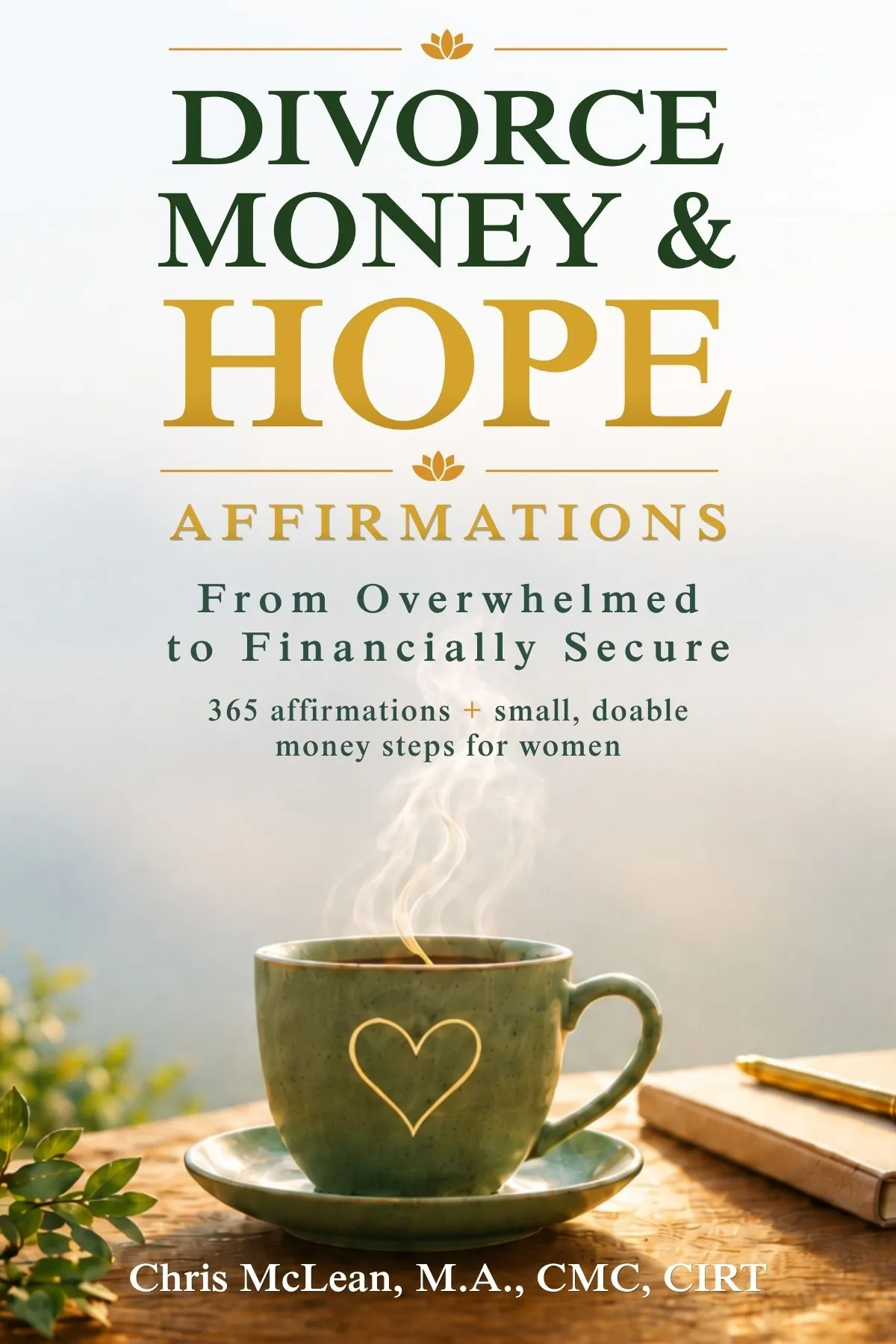
Finally, a book that helps women rebuild their financial confidence — without strict budgets — one small, doable step at a time.
Register today to receive 15 FREE affirmation pages by email — one each day for 15 days. You can also opt in to receive insider book-launch announcements and special pricing offers on the eBook and print editions.
Here's A Preview of What's Inside
Explore 6 sample pages from Divorce Money & Hope to discover the encouragement, practical insights, and new perspectives waiting inside.
The decision I made in pain was still a decision made by a brave woman.
I want to name something I've been carrying quietly. During my divorce, I made a decision — about the settlement, the assets, the terms — that I now suspect wasn't the best decision. Maybe I accepted less than I was entitled to. Maybe I signed something at 2 AM because I couldn't endure one more meeting, one more argument, one more day of this. And now I carry the weight of that decision like a verdict: "I gave away my future because I wasn't strong enough to fight for it."
But here's what I want to say to the woman who made that decision: you were in pain. You were exhausted. You needed the ordeal to stop. And clarity was not available to you in that moment the way it's becoming available to you now.
This page has no desire to judge you for surviving the only way you could. You did your best. And in case no one's ever told you, under those conditions, that was enough.
What decision from my divorce do I keep holding against myself — and what would the words sound like to acknowledge myself with compassion instead of judgment?
-page 135
Not every crash diet involves food. Some involve money.
A budget does with dollars what a crash diet does with calories. It restricts. It monitors. It judges. It creates a cycle of deprivation, compliance and rebellion, which eventually collapses into an ocean of guilt.
That pattern is almost identical whether the subject is food or money. And just like crash diets, strict budgets work for almost no one over time — because they treat the behavior without addressing the feeling underneath it.
I'm not going to budget my way to financial health any more than I could starve my way to physical health. What I'm going to do instead is something quieter, smaller, and far more sustainable: I'm going to start noticing. Not restricting. Not judging. Just noticing where the money goes and what I feel when it leaves.
That's it.
That’s the beginning. And it's the opposite of everything the financial industry has been telling me to do.
What has my experience with budgets been — and how did they make me feel about myself?
* We’ll begin the discussion on how to do the noticing without judgment in the next phase of this book.
-page 147
The system wasn't broken. It was built this way.
Here's a number I want to sit with: women's available household income falls by an average of 41% after divorce. For men, it falls by 23%. That's not because women are worse with money. It's because the system — the pay structures, the caregiving expectations, the career interruptions that fell disproportionately on us — was designed in a way that makes this outcome almost inevitable.
I'm not saying this to create anger, though anger would be justified. I'm saying it because I need to stop blaming myself for an outcome that was partly structural.
The self-judgment I carry about my post-divorce finances isn't all earned. Some of it was assigned to me by a world that still hasn't figured out how to value what women do.
Knowing that systemic forces contributed to where I am — does it change the way I feel about my financial situation? Does it loosen the shame, even slightly?
-page 118
I gave everything away and called it love. I'm learning to call it what it is.
There's a pattern I want to name today — one I lived inside for so long I didn't recognize it as a pattern. I call it the “Over-Giver.”
She gives away her time, her money, her energy, her rest — and calls all of it love. She pays everyone else first and takes whatever's left, which is usually nothing. She says yes to every request because saying no feels selfish. She hasn't bought herself new shoes in two years, but she spent $200 on her children's shoes last month without a second thought. And underneath all that giving is a belief she has never once said out loud: if I stop giving, they'll stop loving me.
But that isn't love. It's a quiet bargain dressed up as generosity. And a woman who gives from a well that ran dry months ago isn't generous — she's depleted. I know, because I've been her. The over-giving felt like devotion. It was actually self-erasure, and the people I love never asked me for it.
Where am I giving more than I can afford — with money or with myself — and calling it love when it's closer to self-neglect? Gently explore this in your journal.
-page 304
The slipper didn't make her who she was. It revealed what was always true.
In the original “Cinderella” story — not the Disney version — she works. She's resourceful. She's clever. The glass slipper didn't create her value. It proved what was already true.
I've been feeling like my financial identity was "lost" in the marriage — that somewhere between the joint accounts and the shared decisions and the years of deferring, I became someone who couldn't handle money.
But my morning practice using this book is teaching me something different. It's not making me into a new woman. It's revealing the woman who was always there — capable, intelligent, worthy of her own financial life. The circumstances obscured her. Clarity is removing the disguise.
What financial capability has been inside me all along — hidden by circumstances, not by any lack of ability?
-page 169
The financial conversation I used to dread is the one I now prepare for.
There's a conversation coming — or maybe it's already here. A negotiation with a creditor. A salary discussion with an employer. A meeting about child support. A conversation with a financial advisor. By using this book, I’m preparing for it differently than I ever have before. Not with dread. With my numbers.
I now know what my life costs. I know what I can offer and what I can't. I know the difference between what a collector claims I owe and what the original balance actually was. I know my rights. And I'm walking into that conversation the way a woman walks into a room when she knows she belongs there: upright, unhurried, and holding real numbers in her hands instead of vague apologies in her throat.
What financial conversation am I preparing for — and how would it feel to be prepared with information instead of anxiety?
-page 335